

How To Draw A Winter House
How to Draw a Tiny Firm Floor Programme
on February 20, 2022
Whether you're buying a tiny business firm, working with a tiny house designer, or designing your own, knowing how to describe a floor plan will assist you lot communicate your ideas and plow them into a real, workable design.
Getting Started
- Start the old-fashioned fashion. Nearly great ideas start out with a quick sketch on paper. Simply a drawing is near useful when it'southward done to scale, assuasive you to understand the size of elements and their relationships to each other.
- Graph paper makes it easy to draw to scale. Observe graph paper with a non-as well-dumbo filigree, or impress your ain. Use a pencil, a pen, a magic marker, or whatever works for you.
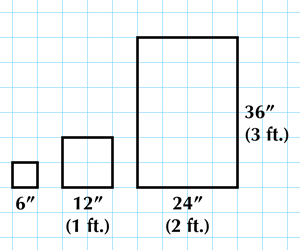
Using the graph paper grid
- You'll want each square of the filigree to equal some piece of cake fraction of a pes, like 3", 4", half-dozen", or 1′. Choose 1 of these (say vi") and multiply it by the number of grid squares on your graph newspaper (say, 30×39). That gives 180×234", or xv×19.five′ (divide inches past 12 to get feet). So, at that scale on that piece of newspaper, y'all take room to draw something up to 15′ wide and 19′-6" long. A 24" square table would be four grid squares long by four filigree squares wide.
- Graph paper makes it easy to draw to scale. Observe graph paper with a non-as well-dumbo filigree, or impress your ain. Use a pencil, a pen, a magic marker, or whatever works for you.
- Architectural cartoon software. There are lots of software programs out there, some free, some inexpensive, some very expensive. While professional designers often use AutoCAD, you don't need anything then serious. The same company offers a free, web-based floor plan design tool. If yous take had good (or bad) experiences with other design software, please share it in the comments!
- SketchUp. A lot of tiny house designers have plant SketchUp to be very useful. SketchUp is a gratuitous 3D modeling program that is not hard to learn. With this software, you can blueprint not only the floor plan but besides the full three-dimensional blueprint and details for your tiny house. Tutorials are available online, and Michael Janzen from Tiny Firm Design has washed a very helpful video tutorial series on how to draw a tiny firm on a trailer with SketchUp.
Knowing how big things are
- Don't forget wall thicknesses. It'southward piece of cake to practise, only if you leave out wall thickness in a tiny house, it adds upwardly. If you lot don't know exactly how thick your walls will be, guess. A typical two×4 stud wall with ane/two" drywall on either side is 4-one/2" thick.
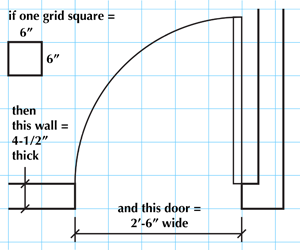
Drawing a door in a wall
- Know your doors. Residential doors range in size.
- Doors range in width, usually in two" increments (ii′-vi", two′-viii", and then on). The standard front end door on new American houses is 3′ wide and 6′-8" tall, but this may be too wide for a tiny house. The old standard front door size was ii′-viii". Consider the size of your largest piece of piece of furniture—will information technology fit in your chosen front door?
- Make sure to depict the door swing on the plan. Check that the door swing does not hit other doors, fixtures, or furniture. If you accept a tight space, consider a pocket door.
- Doors near a corner should be at least 3-4" from the corner to leave infinite for trim.
- Know your windows. Draw your windows on the program. Windows sizes vary. Common widths, for basic layout of a floor plan, are 1′-six", 2′-0", 2′-6", and 3′-0". If windows swing in or out, draw the swing on the plan. For more information on the types and sizes of windows (and doors) out there, look at manufacturers similar Pella and Jeld-Wen.
- Be realistic about article of furniture. Furniture takes up space. Get out a measuring tape and measure your furniture, and yourself sitting in it. Or await online for a variety of "standard" dimensions.
- Understand kitchen dimensions. Kitchen base cabinets are typically 24" deep, with a counter that is 25-1/2" deep. Typical cabinet widths are in 3" increments (9", 12", ane′-3", ane′-6", etc.). Upper cabinets are typically 12" deep and come in the same widths. Ideally, at least 36" of piece of work space should be allowed in front of the cabinets, with 42-48" beingness more comfortable.
- Understand bathroom dimensions. Edifice codes establish some guidelines that are helpful to know, whether or not you lot're building to code. For case, there must typically be at to the lowest degree 15" from the eye of the toilet to either side wall, for a total of 30" between walls (although this will be a little tight for some people, who may prefer 36"). There should be 21" clear space in forepart of the toilet.

A realistic floor plan showing walls, doors, windows, kitchen cabinets, fixtures, and furniture.
Special considerations
- Plumbing walls. If you lot take a plumbed toilet, the plumber needs to be able to run a vent pipe vertically through it, so try to locate it near a wall at least two×4 if not 2×6, and preferably an interior wall.
- Shear walls. In a long, narrow house, side-to-side forces from air current and potentially earthquakes will put the almost strain on the short end walls. Typically, the capsule on those walls is what resists these shear forces, so try not to fill these walls entirely with doors and windows that reduce the sheathing area. As well, try to go on doors and windows a little away from each exterior corner, for extra forcefulness (24" is bang-up if yous tin can get it).
- Passive solar design. Orientation and window placement are key aspects of passive solar design. Check out my post on passive solar from a couple weeks dorsum for some tips.
Looking for inspiration?
- Wait into small house books (I recently picked up Compact Cabins by Gerald Rowan and take found it very helpful) or gratuitous plans on the cyberspace (such as Michael Janzen'southward gratis tiny house plans at Tiny Business firm Pattern) for ideas.
- Learn a little bit about feng shui. I don't personally buy into (or even understand) all the depths of feng shui; that said, I've found information technology to be useful source of principles for home layout and blueprint. Most.com has an extensive section on feng shui. Take what y'all detect useful, ignore what you don't.
- Simplify, simplify, simplify. A simple plan is easier to build and may feel less chaotic. It can be fabricated interesting and cute by vertical variation (window and ceiling heights and then on) and cloth choices, and I'll talk most both of those things in the coming weeks.
Annotation: Last week I announced that this calendar week's article would be about insulation. While that is an interesting topic (at to the lowest degree, if you're a edifice scientific discipline geek), it's not really specific to tiny houses—the same principles apply to all houses. If you were really looking forrad to a thorough discussion of insulation this week, sorry to disappoint—but I'll link to few resources that go into the various options in depth: an article on insulation materials from the Department of Energy
and another on thermal control in buildings from the Building Science Corporation.
Have you been designing your own tiny business firm floor plan, or are you lot not sure where to start? Share your designs, and lessons learned, in the comments beneath! Next week, nosotros'll switch axes and talk nigh the vertical dimension in tiny houses.
The following ii tabs change content below.
- Bio
- Latest Posts

Vincent Baudoin is a designer and architect with a groundwork in public interest design, sustainability, and integrated pattern-build.

Source: https://tinyhousetalk.com/how-to-draw-a-tiny-house-floor-plan/
Posted by: wrightititan79.blogspot.com
0 Response to "How To Draw A Winter House"
Post a Comment